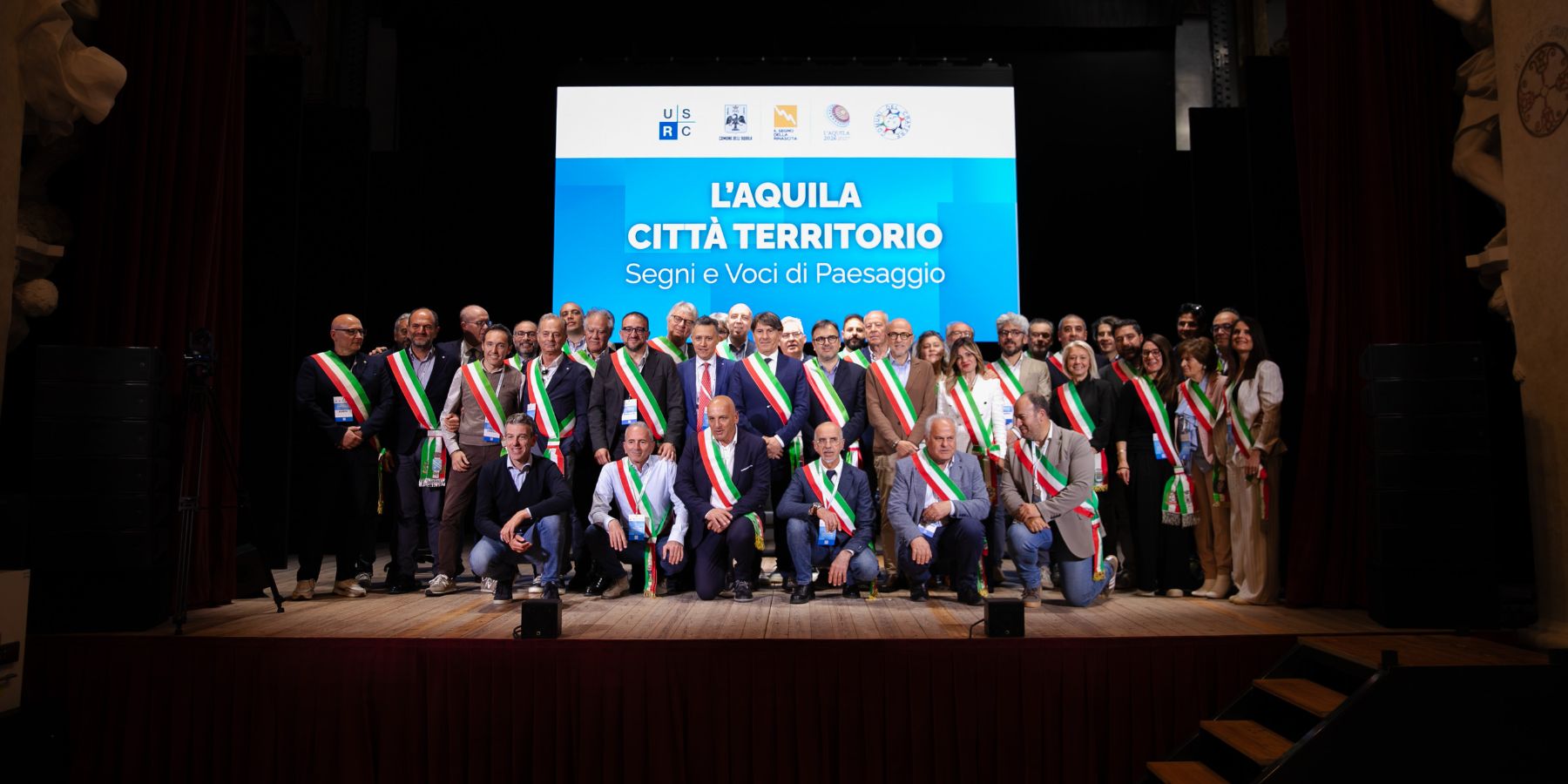
The participatory co-design initiative promoted by the City of L’Aquila and coordinated by the USRC came to a close at the Teatro San Filippo. It was a journey through contemporary art, memory, and urban regeneration aimed at transforming the inner city areas into a widespread museum beyond 2026.
The final meeting served as a public presentation of the work carried out over the past few weeks through working groups, listening sessions, and discussions involving as many as 61 local governments, over 40 cultural operators, associations, and local communities in the L’Aquila earthquake zone.
From local workshops to calls for proposals for municipalities and artists
The first part of the meeting was devoted to presenting the results that emerged during the regional workshops coordinated by Medaarch. This was followed by an institutional discussion on the project’s future prospects and the upcoming operational phases that will guide the regions toward the implementation of the widespread artistic interventions.
Over the past month, four working sessions were held in Cugnoli, Colledara, Montereale, and San Demetrio ne’ Vestini, organized into 16 working groups, culminating in today’s closing meeting at the San Filippo Theater in L’Aquila.
The Emotional Geography of the Crater and the Identification of “Points of Intensity”
The project unfolded in several phases: from the emergence of memories and symbolic figures associated with the territories to the identification of physical and cultural heritage markers, and finally to the gathering of the communities’ vulnerabilities, aspirations, and visions for the future. From this emerged a shared narrative capable of guiding each municipality in identifying its own “point of intensity”—that is, the symbolic location designated to host future widespread contemporary art installations.
The material gathered during the workshops (annotated maps, narratives, keywords, and identity markers) has revealed an emotional and cultural geography of the crater’s territories, which will serve as the foundation for the next operational steps. In fact, the materials developed will guide the future call for proposals directed at municipalities and the work of the artists who will be asked to design projects capable of engaging with the history, identity, and emotional fabric of these territories.
The program’s goal is not only to create public artworks, but also to build a constellation of permanent and recognizable landmarks capable of strengthening communities’ sense of belonging and fostering new cultural connections between cities and inland areas.
Mayor Pierluigi Biondi: “A development model that brings together inland areas”
“A process that has truly placed communities, mayors, associations, cultural operators, and citizens of inland areas at the center. The high turnout at all the regional meetings demonstrates just how strong our municipalities’ desire is to play a leading role in a new era of development based on unity, on the true city-territory concept, and on the promotion of local identities. Inland areas are places rich in history, energy, skills, and human capital.
“Through this collective effort, we have built a genuine model that everyone can draw inspiration from. This is the deepest meaning of our year as the Italian Capital of Culture: to leave behind a stable network of relationships, projects, and opportunities that will continue to generate value well beyond 2026,” says Pierluigi Biondi, mayor of L’Aquila.
Gianni Anastasio (Mayors’ Coordinator): “Crossing Borders to Build Networks for the Future”
“Seeing local governments, communities, cultural organizations, and regions come together around a shared vision has been one of the most significant aspects of this journey,” said Gianni Anastasio, coordinator of the Mayors of the Crater — MAPS has demonstrated just how eager the municipalities of the Crater are today to network, share ideas, experiences, and perspectives, transcending the boundaries of individual territories to build a new collective narrative together.”
“The atmosphere of collaboration and participation that emerged during all the meetings is a significant achievement, as it confirms the growth of a local community that is increasingly ready to work together on the cultural and social future of the region.”
Raffaello Fico (USRC Director): “Beyond 2026, Public Art as a Lasting Legacy”
“With the conclusion of the MAPS initiative, a very important phase of listening, dialogue, and collaborative creation—which involved local governments, cultural professionals, artists, and local communities throughout the ‘crater’ region—has come to a close,” said Raffaello Fico, director of the USRC. “Over the past few months, we have built something that goes beyond a simple cultural project: we have launched a collective process that places memories, landscapes, identities, art, and relationships at the center, fostering a renewed awareness of the value of our territories.”
MAPS has demonstrated just how strong the communities’ desire is to actively participate in building a shared vision for the future of inland areas, using art and culture as tools for connection, storytelling, and territorial regeneration. Now a new operational phase is beginning, which will lead to the publication of public notices and the transformation of the ideas gathered into concrete public art projects, widespread local storytelling, and the artistic enhancement of these places.
The goal is not simply to create works of art, but to leave permanent and recognizable marks capable of strengthening the identity of local areas, generating new cultural and artistic connections, and building a widespread, shared heritage. It is important to emphasize that this journey does not end in 2026. The work that has begun has no defined time limit; rather, it represents the beginning of a long-term vision based on collaboration among regions, community participation, public art, and culture as drivers of social, cultural, and regional development.”