
L’ Aquila, February 2026 – The project for the construction of a campus for the expansion and redevelopment of the headquarters of the Academy of Fine Arts of L’ Aquila was presented today at Palazzo Margherita, the seat of the Municipality of L’Aquila.
This project involves approximately 9.5 million euros (9,472,597.78 euros) allocated by the Ministry of Universities and Research in 2024. The project aims to: enhancethe educational offerings, improveenergy efficiency, and enhance the outdoor areasof the L’Aquila-based institute of higher education in the arts.
The total project area—including both built-up space and outdoor green spaces or areas adapted to the needs of the student body—covers 22,880 square meters, to be developed between the historic campus designed by star architect Paolo Portoghesi and the more modern wing, as well as at the very entrance to the current building.
There are three main measures:
- construction of a solar farm on the area currently used as a parking lot, with steel canopies covering approximately 76 parking spaces, as well as spaces for bicycles, scooters, and kick scooters. The goal is to help make the building energy self-sufficient;
- Construction of anoutdoor amphitheater designed as a gathering space and outdoor theater to address the current difference in elevation between the parking lot and the Academy’s facilities
- Expansion of educational spaces through the construction of new wings with a total floor area of 1,200 square meters, to be used for classrooms, laboratories, exhibition spaces, and common areas.The new project, designed by Studio Paoloni – Scoccia – Laurini of L’Aquila, will be carried out in accordance with criteria of flexibility, safety, energy efficiency, and architectural integration with the existing complex, while the outdoor spaces will also be available for local cultural activities. The project, which has been reviewed and approved by the Academy of Fine Arts, will have the Province of L’Aquila as the sole contracting authority.
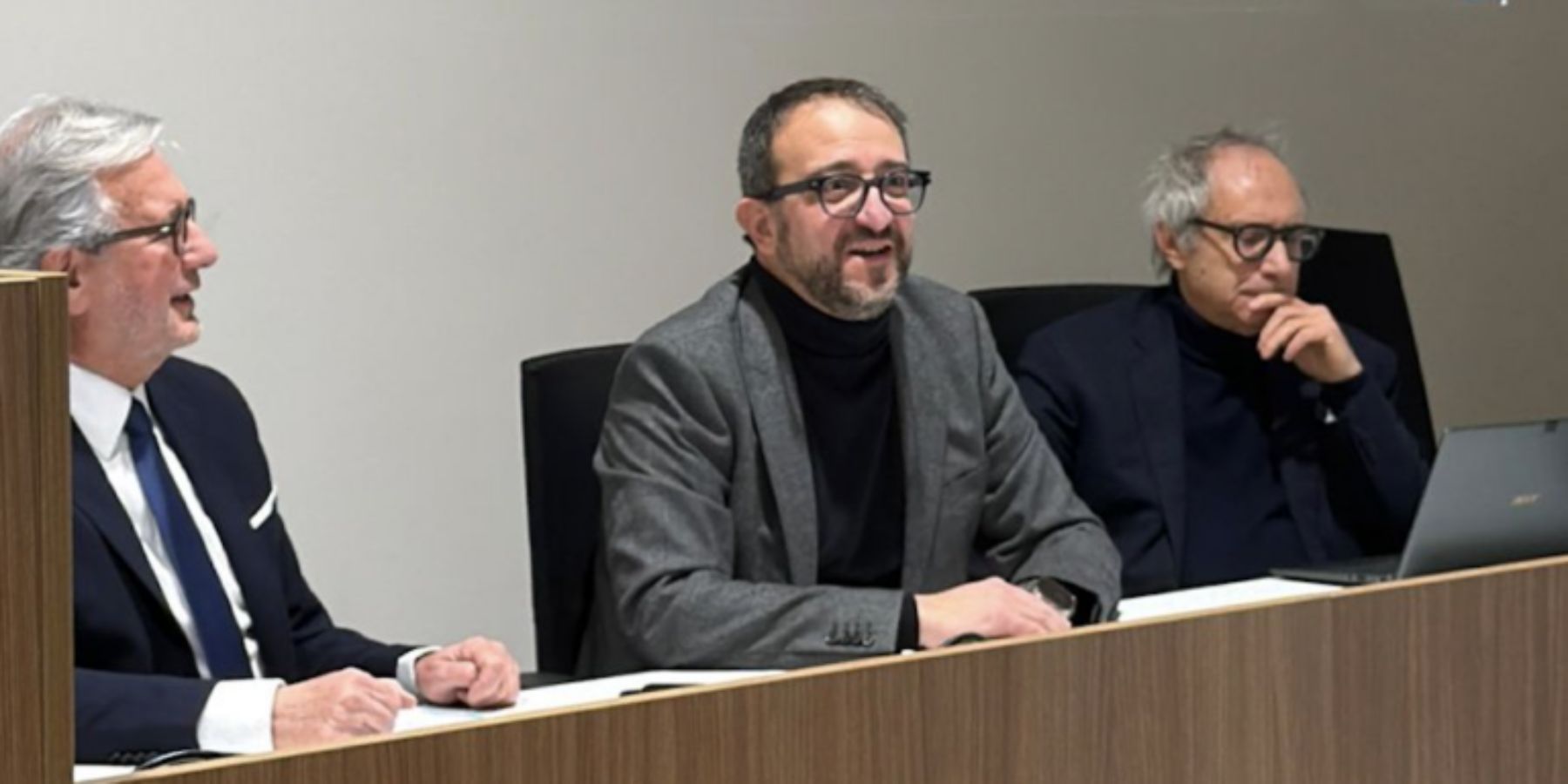
Present at this morning’s presentation were the Mayor of L’Aquila, Pierluigi Biondi; ABAQ President Rinaldo Tordera and Director Marco Brandizzi; Project Manager Massimo Di Battista; and designers Eleonora Laurini and Diego Scoccia.
“This is a major leap in quality for our academy ,” explained ABAQ Director Brandizzi, “ because ours will be the only one to have a space that integrates energy infrastructure, architecture, and teaching spaces, as well as places for human relationships. This will be achieved through the creation of an innovative yet replicable model for the redevelopment of higher education schools like ours, especially in areas with high seismic vulnerability and complex urban contexts. This project will also significantly improve the quality of our teaching, but also the working lives of both students and the teaching and administrative staff in general .”
“I am very proud of this milestone achieved by our Academy, which was made possible by everyone’s hard work and efforts ,” added President Tordera. “For this reason, I want to thank everyone at our institution who contributed to this result, but first and foremost, I would like to thank the Ministry of Education, Universities, and Research (MUR), represented by Minister Anna Maria Bernini, who immediately recognized the value of this initiative and provided the necessary funding. Thanks also go to Mayor Biondi forthe support and collaboration thatthe administration provides for our initiatives. Today we presented the project, which has been approvedby the Academy andwillnowundergo review and validation by the relevant authorities,thereby launching thebiddingprocess.Work is scheduledto begin in 2026, in accordance with the timeline, and is expected to be completed within two years.”
“The expansion of the Academy of Fine Arts of L’ Aquila,” Mayor Biondi concluded, ” represents a strategic investment in the future of the city . In recent years, we have seen a significant increase in enrollment. These figures reflect a city increasingly attractive to young people and increasingly capable of engaging internationally, the result of a vision that places culture at its center as a primary, not ancillary, infrastructure. The Academy, with its history of experimentation and its ability to innovate languages and skills, is one of the pillars of the contemporary city. In a year like this Just as significant as the title of Italian Capital of Culture, investing inthe Academy means strengthening one of thepillars of our cultural and creative ecosystem. ‘One region, a thousand capitals’’ also means this: offeringconcrete opportunities for training and employment, and creating the conditions so thatyoung people to choose to stay or come to live in our inland regions.”