
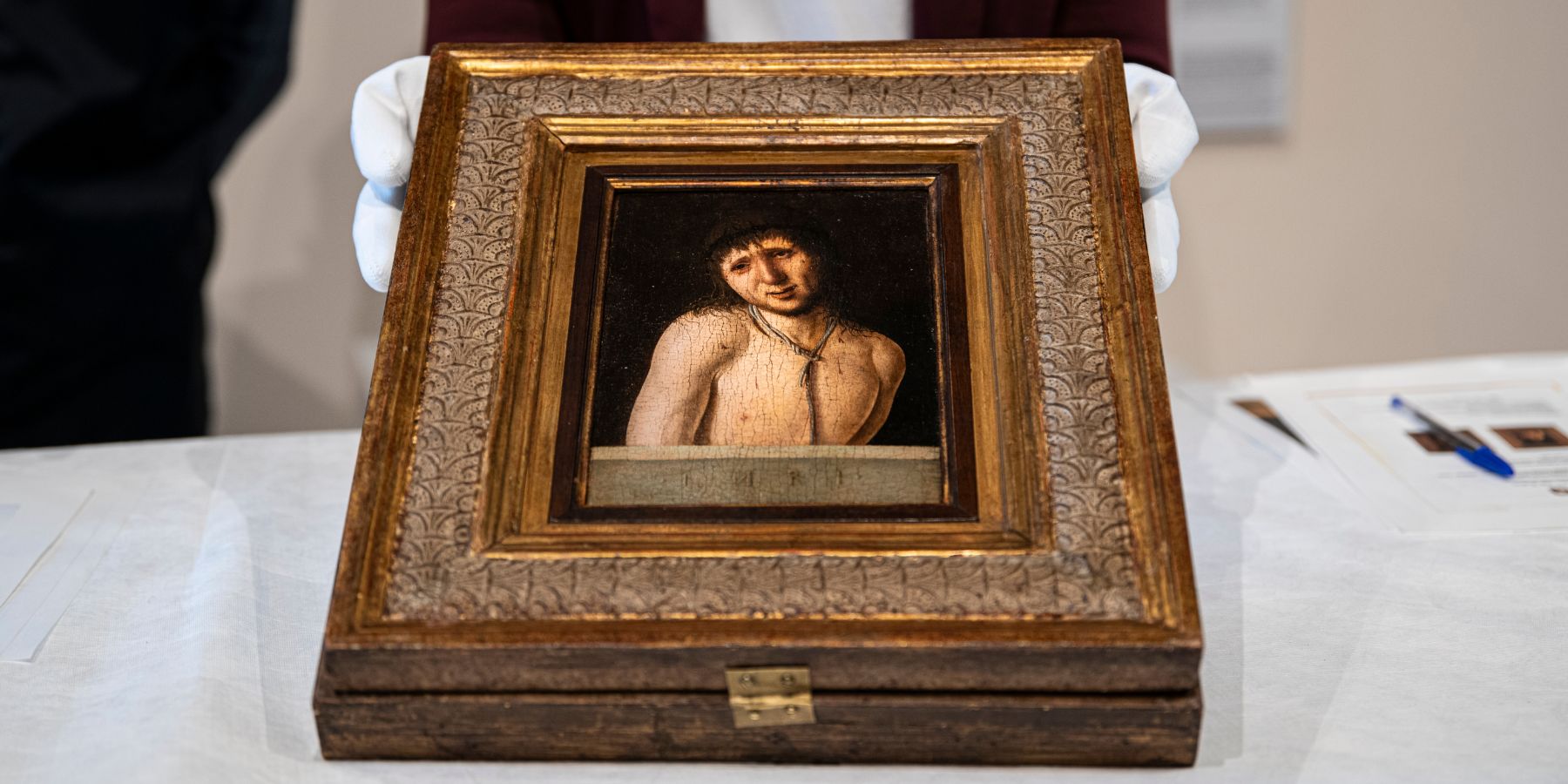
One of the most famous paintings of the Italian Renaissance is joining the permanent collection of the National Museum of Abruzzo. On June 8, 2026, as part of L’Aquila’s designation as Italian Capital of Culture, the MuNDA will host the unveiling ceremony for Antonello da Messina’s “Ecce Homo,” recently acquired by the Italian government through the Ministry of Culture. From 8:00 p.m. to midnight, there will be a special public opening.
L’Aquila is preparing to host one of the most significant cultural events of its year as the Italian Capital of Culture—and, more broadly, in the history of museums in Southern Italy. On Monday, June 8, 2026, the National Museum of Abruzzo (MuNDA), set within the 16th-century Castle of L’Aquila, will officially welcome Antonello da Messina’s “Ecce Homo”: this 15th-century panel painting—one of the most studied, reproduced, and beloved works of the Italian Renaissance, recently acquired by the Ministry of Culture for the national heritage—will find its permanent home in L’Aquila.
The event is the result of a collaboration between the Ministry of Culture, the City of L’Aquila, and MuNDA, and will be attended by Minister of Culture Alessandro Giuli and L’Aquila Mayor Pierluigi Biondi.
Antonello da Messina’s “Ecce Homo”: Why It Is a Masterpiece
Painted in the second half of the 15th century, Antonello da Messina’s “Ecce Homo” is one of the absolute masterpieces of European Renaissance painting. The panel depicts Christ after the flagellation—the moment described in the Gospel of John with Pilate’s words “Ecce Homo,” “Behold the man”—with a psychological intensity and a rendering of suffering that are unmatched in the Italian pictorial tradition of the time.
Antonello da Messina, a Sicilian painter active in the second half of the 15th century, was the figure who, more than any other, brought the technical revolution of Flemish oil painting to Italy, transforming it into a tool for exploring the human face and soul. No work illustrates this synthesis with the power of “Ecce Homo”: Christ’s gaze—which looks directly at the viewer—has spanned five centuries without losing any of its unsettling immediacy.
The June 8 Program: Media, Institutions, and Citizenship
The opening day is divided into three distinct segments, each aimed at a different audience.
6:00 p.m. — Media-only preview
The day begins with a preview for the press and television, a session set aside for filming and interviews with:
- Federica Zalabra, Director of MuNDA
- Luigi Oliva, Director of the ICR (Central Institute for Restoration)
6:30 p.m. — Official ceremony
This is followed by the official inauguration ceremony, attended by Minister of Culture Alessandro Giuli, Mayor Pierluigi Biondi, and other officials. It is the moment when the “Ecce Homo” is formally presented to the city of L’Aquila and its museum.
8:00 p.m. – 12:00 a.m. — Special evening opening to the public
The evening concludes in the most meaningful way: from 8:00 p.m. to midnight, MuNDA will exceptionally open its doors for a special evening unveiling of the artwork, open to all citizens. Last admission is at 11:00 p.m. For the occasion, discounted admission and special rates for families will be available. All information is available on the Ministry of Culture’s website: cultura.gov.it.
A Strategic Choice: Why L’Aquila and Why MuNDA
The arrival of “Ecce Homo” at MuNDA is not an isolated event: it is the first step in a strategic initiative aimed at linking the National Museum of Abruzzo to the National Museum System by incorporating true masterpieces into the local museum circuit.
The rationale is that of cultural investment as a driver of regional development: projects of this caliber attract high-quality tourists, generate resources for research and conservation, and produce a structural—rather than sporadic—economic return. In this sense, the choice of L’Aquila is also a choice of approach: to demonstrate that Italy’s inland regions—and those affected by natural disasters—can establish a competitive cultural leadership at the national and European levels.
“The arrival of a work of such exceptional value demonstrates how culture is the cornerstone upon which our reconstruction is ultimately built. We are moving from the celebration of beauty to the establishment of a managerial and scientific model, transforming artistic excellence into a systemic competitive advantage that is indispensable for Italy’s inland regions. This initiative is not an isolated event, but a strategic investment against depopulation, capable of generating an economic return. It is one of the ‘legacies’ of *Capitale* that recognizes the courage and uniquely L’Aquila-style ability to have risen to the challenge of social reconstruction. For this reason, I am grateful to Minister Giuli for his attention and insight,” stated the mayor of L’Aquila, Pierluigi Biondi.
Practical Information
| Date | Monday, June 8, 2026 |
| Museum | MuNDA – National Museum of Abruzzo |
| Address | 16th-Century Castle, L’Aquila |
| Media Preview | 6:00 p.m. |
| Official Ceremony | 6:30 p.m. |
| Evening Public Hours | 8:00 p.m. – 12:00 a.m. (last admission at 11:00 p.m.) |
| Admission Discounts | Various discounts for entry and special conditions for families ( cultura.gov.it ) |
As part of the program for L’Aquila, Italian Capital of Culture 2026, in collaboration with the Ministry of Culture and the City of L’Aquila.