
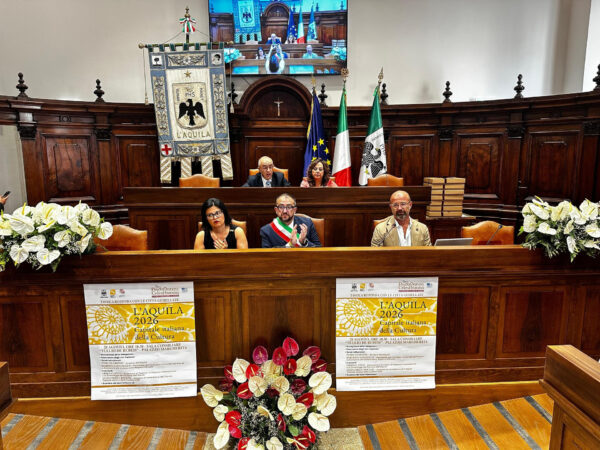
As part of the 731st edition of the Perdonanza Celestiniana—a UNESCO Intangible Cultural Heritage of Humanity since 2019—the traditional welcoming ceremony for delegations from L’Aquila’s sister cities took place this morning in the “Tullio De Rubeis” Council Chamber of Palazzo Margherita, the traditional welcoming ceremony for delegations from L’Aquila’s sister cities.
The event, organized by the Department of Tourism, International Relations, and Sister Cities of the City of L’Aquila, was enhanced this year by a roundtable discussion dedicated to “L’Aquila, Italian Capital of Culture 2026,” included in the official program of the Perdonanza, which provided an opportunity to reflect on the role of the capital of Abruzzo in its journey toward this prestigious goal.
The mayor of L’Aquila, Pierluigi Biondi, delivered the official remarks.
Speakers included: Ersilia Lancia, Councilor for Tourism, International Relations, and Sister Cities for the City of L’Aquila, and Alessandro Crociata, director of L’Aquila’s bid to become the 2026 Italian Capital of Culture, who outlined the strategic guidelines and projects that will involve institutions, associations, and citizens in a shared vision of cultural and social growth.
“On the occasion of the Perdonanza, we are once again hosting our institutional meeting with delegations from our sister cities, which this year features an explicitly intercultural dialogue, as we wanted to use this occasion to reflect on the 2026 Italian Capital of Culture,” said Ersilia Lancia, Councilor for Tourism, International Relations, and Sister City Partnerships for the City of L’Aquila. “I believe that the thematic link to culture and the idea of a culture-based development model can inspire the diplomacy of local governments, which is necessarily underpinning sister city partnerships. Through culture, we can strengthen the values of friendship, cooperation, identity, and mutual understanding that characterize our relationships with our sister cities, and we must continue to work toward this,” concluded Councilor Lancia.
The following sister cities were represented: Rottweil (Germany), represented by Marc Schaffert, Councilor for Culture; Zielona Góra (Poland), represented by Joanna Malon, Vice President of the City Council, and Iwona Burchardt, Director of the European Funds Department; Bistrita (Romania), represented by Deputy Mayor Stefania Stere; Erba (Italy), represented by Maria Francesca Frigerio, Councilor for Social Policies; Sant’Angelo D’Alife (Italy), represented by Mayor Michele Caporaso; City Councilor for Urban Affairs Angelo Rossolino; twin city delegate Maria Gilardi, City Councilor; Micaela Bucci, City Councilor; Rosalba Marino, City Councilor; and Elisabetta Simonelli, City Councilor.
Also present was the city of Assisi (Italy), represented by Mayor Valter Stoppini—a city that is not a sister city but with which we maintain ties based on faith and popular devotion to Saints Francis and Celestine, as well as on the common ground found in their messages of peace and forgiveness. Moreover, just yesterday, the City of Assisi was awarded the 2025 Prize for Forgiveness, an honor that the Perdonanza Committee bestows upon organizations and individuals of the highest caliber. The award, presented to Mayor Stoppini, was given to the entire community of Assisi “for its commitment as peacemakers, following the path laid out by Saint Francis, a messenger of brotherhood, a champion of the universal value of forgiveness, and an apostle of respect for all creatures.”
The presence of foreign and Italian delegations reaffirmed L’Aquila’s role as a hub for dialogue, exchange, and cooperation. The meeting concluded with a joint commitment to strengthen the value of sister-city relationships in anticipation of the major challenge and opportunity of 2026.