
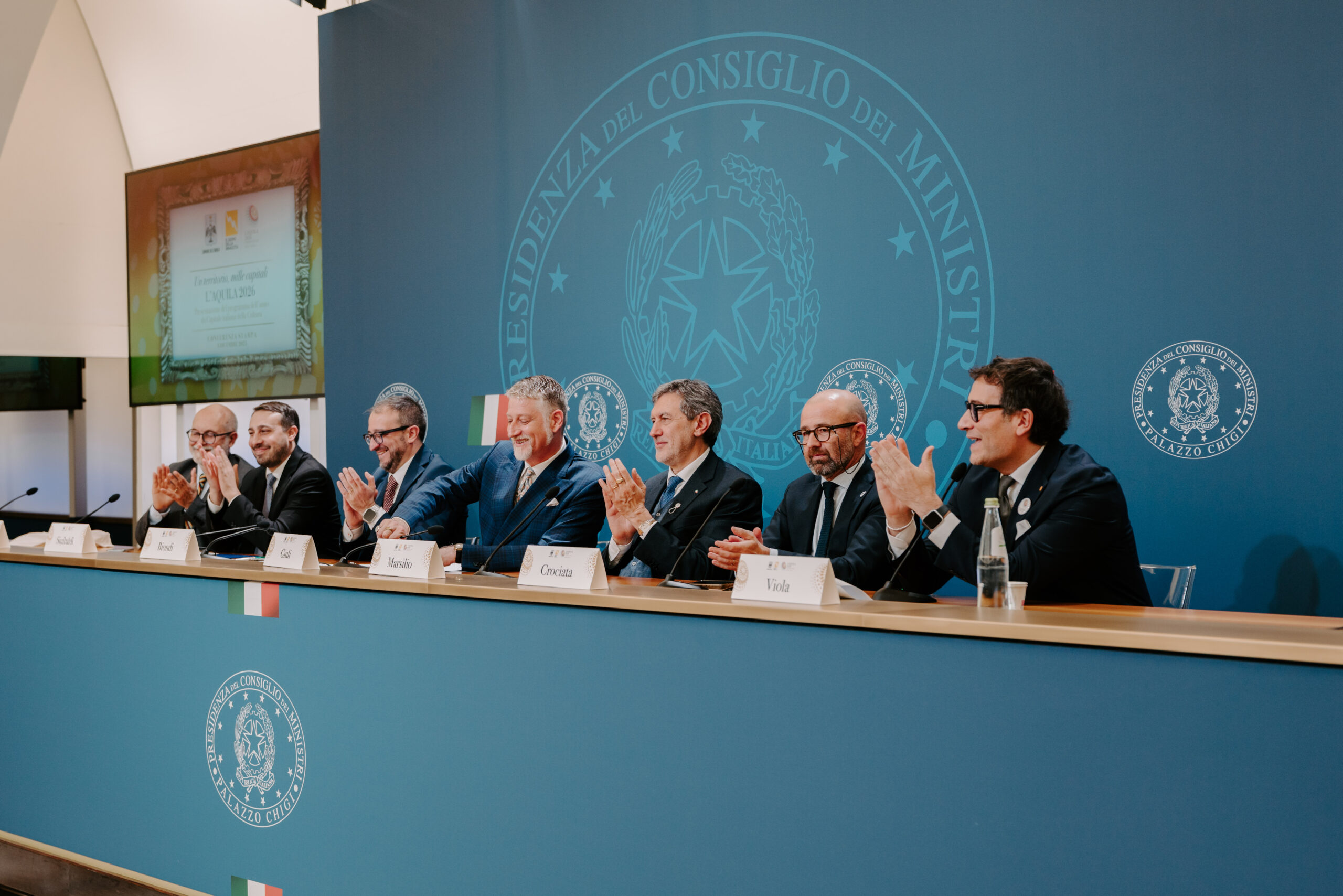
300 events, 300 days of programming, a national model for the revitalization of inland areas, and Italy’s first observatory dedicated to measuring its impact. Biondi: “Our strength lies in the unity of a broad, polycentric, and evolving community”
Rome, December 3 — This morning, in the multipurpose hall of the Presidency of the Council of Ministers, L’Aquila presented its official program for Italian Capital of Culture 2026: over 300 events over 300 days, featuring international guests, spanning art, music, theater, film, dance, public engagement, and research.
The project—which will kick off with an official ceremony on January 17—stands out for its strong sense of identity, the result of a participatory process that focuses on medium-sized cities and vulnerable inland areas of the Apennines, defining a replicable model for revitalization. L’Aquila, Capital of Culture, is more than just a year of events: it is a structural project that goes beyond the traditional concept of a single city, proposing instead a polycentric model that highlights a vast, interconnected territory. The historical and scenic richness of the villages interacts with the cities through human capital, the determination, and the creative ingenuity of the inhabitants themselves.
The conference, moderated by journalist Alessio Viola, was attended by the mayor of L’Aquila, Pierluigi Biondi, and the Minister of Culture, Alessandro Giuli, as well as the scientific coordinator of the bid, Pier Luigi Sacco; the bid director, Alessandro Crociata; the mayor of Rieti, Daniele Sinibaldi; the president of the Abruzzo Region, Marco Marsilio; and representatives of the Committee of Guarantors and the Private Support Committee.
Mayor Biondi outlined the program’s key figures and the project’s guiding principle: “One Territory, a Thousand Capitals,” the nation’s first true “diffused capital.” “Not a city, but a region. Not a capital, but a thousand capitals: places, institutions, towns, and—above all—a thousand human capitals. Our strength lies in the collective spirit of a broad, polycentric, and evolving community,” declared Biondi, emphasizing that the winning bid for 2026 is the result of a collaborative effort that also involved the Municipality of Rieti and the areas affected by the 2009 and 2016 earthquakes.
The mayor also pointed out that the City of L’Aquila’s total investment for 2026 alone—including cultural programming, major exhibitions, productions, community-based activities, and urban regeneration initiatives—amounts to over 16 million euros, a sign of a clear political commitment: to complement physical reconstruction with a structural cultural strategy capable of shaping the future. He then noted how the program showcases the region’s cultural excellence by hosting original productions of national significance.
Just to give an example, commissioned by the “Bonaventura Barattelli” Concert Society of L’Aquila to mark the 80th anniversary of its founding, the world premiere of Nicola Piovani’s work; in collaboration with the Istituzione Sinfonica Abruzzese, the words of Davide Rondoni, the music of Roberto Molinelli, and the vocals of Simona Molinari come together in a new project marking the 800th anniversary of the death of St. Francis; I Solisti Aquilani are organizing the first edition of the “Vittorio Antonellini” International Conducting Competition for young conductors, with a jury chaired by Salvatore Accardo, marking the 10th anniversary of their founder’s passing. In 2026, the city’s signature events—the Perdonanza Celestiniana, I Cantieri dell’Immaginario, Jazz Italiano per le Terre del Sisma, and the Festival delle Città del Medioevo—will also return with an expanded program.
The scientific coordinator of the bid, Pier Luigi Sacco, full professor of Biobehavioral Economics at the University of Chieti-Pescara, noted that culture is a primary form of infrastructure for inland areas, capable of producing measurable impacts on well-being, health, social cohesion, and regional attractiveness. ““We hear more and more often that culture brings health benefits, as recognized by the WHO. With L’Aquila 2026, we will take it a step further: we will demonstrate how the capital’s constant exposure to culture throughout the year produces concrete effects, not only on mental health but also on physical health.”
The president of the Abruzzo Region, Marco Marsilio, reiterated that “2026 will be an opportunity to show Italy and Europe a city that today stands as a living laboratory of cultural regeneration, a place of encounter, dialogue, and innovation. L’Aquila, Italy’s Capital of Culture, highlights how cultural heritage is a force capable of mending the social fabric, restoring identity and confidence, and generating new creative and economic energy. With its restored heritage and new initiatives, the city demonstrates that it has not only a past but also a future: a future founded on beauty, knowledge, and community participation. The Region’s role is to ensure the coordination of an integrated investment so that this outcome translates into tangible benefits for the entire region.”
Alessandro Crociata, full professor of applied economics at the University of Chieti-Pescara and director of the bid dossier, described the concept of “Diffused Capital” as a “mosaic of capitals.” “With L’Aquila 2026,” he explained, “we have applied a model of cultural development that highlights the role of medium-sized cities as drivers of the regional economy. The bid dossier stems from this broad regional vision and from a concrete dialogue between L’Aquila, its surrounding area, and Rieti, which faces the same challenges and opportunities. L’Aquila is home to Italy’s first Urban Cultural Observatory: a tool that will measure the impact of cultural policies and provide useful data to guide local development at the national and international levels.”
The mayor of Rieti, Daniele Sinibaldi, explained the value of the interregional partnership: “We are about to experience a pivotal opportunity to showcase the regions of L’Aquila, Rieti, and the entire central Apennines, which—through this project as well—will prove that they deserve attention and a central role on the national stage thanks to their extraordinary cultural riches that still preserve and safeguard Italy’s deep-rooted identity. Rieti will play a leading role alongside L’Aquila, with enthusiasm and pride.”
The “L’Aquila, Capital of Culture 2026” Program: 300 Events, 300 Days
The program features over 300 events. Among the many initiatives on the calendar, a few stand out: to mark the centennial of Fabio Mauri’s birth (1926–2009), an exhibition curated by Maurizio Cattelan and Marta Papini pays tribute to the artist, a central figure in Italian art and 20th-century thought. The exhibition, scheduled for fall 2026 at MAXXI L’Aquila, focuses on the works that Fabio Mauri conceived and staged from 1979 to 1999, a period during which he taught “Aesthetics of Experimentation” at the Academy of Fine Arts in L’Aquila, highlighting the connection between his work, the city, and its inhabitants.
And then, again in collaboration with MAXXI L’Aquila, the exhibition *Convergences and Continuities: Architecture and Urban Landscapes in Abruzzo, 1930–1960, curated by Mario Centofanti, Raffaele Giannantonio, and Andrea Mantovano, was hosted from June through December at Palazzo ONMI. The exhibition traces a continuous thread in the development of the urban landscape in Abruzzo from the 1930s to the 1960s through graphic materials, photographs, and documents drawn from public and private archives, as well as a commissioned series of artistic photographs by Andrea Jemolo, to reinterpret the architecture featured in the exhibition within the context of today’s urban landscape.
Furthermore, at the end of May, with Marinella Senatore’s “Sond – The School of Narrative Dance,” the city will be transformed into a city-wide stage, involving residents, organizations, schools, and groups in a parade of dance, music, theater, and shared creativity. The project was presented by the MAXXI Foundation, which will coordinate its implementation.
“Beyond the Visible” is a project by Chinese artist Liu Bolin, produced by Audentes Consulting – Strategital Vanguard in collaboration with Galleria Gaburro, which aims to highlight the iconic sites of the Abruzzo region through art. Liu Bolin, known internationally as “the invisible man” for his performances blending into urban and natural spaces, will create three previously unseen photographs at iconic locations in L’Aquila and Abruzzo: the Basilica of Santa Maria di Collemaggio, Rocca Calascio, and the ancient forests of the Abruzzo, Lazio, and Molise National Park. Each image will be the culmination of a public performance in which the artist, through body painting, will blend into the landscape, creating powerful and symbolic works. Produced in a limited series, they will be exhibited in the city from June through September in a venue selected in collaboration with the municipal administration.
Ample space is devoted to institutions of higher education in the arts and music. In fact, L’Aquila will host the 20th edition of the National Arts Award, and—in collaboration with the city’s Academy of Fine Arts—it will also host the academies of Rome, Naples, Brera, Carrara, and Ravenna for a major exhibition of contemporary sculpture.
The “A. Casella” Conservatory will conclude its international tour with the ItARTS – Back to L’Aquila festival in February. The “Ecosystem of Cultural and Creative Enterprises and Internationalization” project, on the other hand, involves a twinning partnership with Bourges—a French city in a rural area, similar in size to the capital of Abruzzo—which will be the European Capital of Culture in 2028.
With the one million euros allocated by the Ministry of Culture, a range of cultural initiatives are being launched, including participatory programs and initiatives promoting active citizenship (such as the one with Michelangelo Pistoletto’s Cittadellarte Foundation), urban regeneration and digital innovation projects, and pilot initiatives in neighborhoods and villages across the region.
The year as Cultural Capital also involves the restoration of several cultural sites, 17 years after the earthquake: for example, the reopening of the Teatro Comunale in 2026, which will then host the year’s closing event with a major opera production by the Teatro Stabile d’Abruzzo, and the return of the National Museum of Abruzzo to the 16th-century castle in December 2025. The Teatro San Filippo will also reopen to the public, having been restored in part thanks to proceeds from the song “Domani,” created in the aftermath of the earthquake by Artisti Uniti per l’Abruzzo. All projects have been approved by a broad, cross-sector committee of guarantors composed of experts, special offices for reconstruction, the Abruzzo Region, and representatives of the City Council. There is also a Support Committee, formed by ANCE of the Province of L’Aquila and the Carispaq Foundation, to support and co-fund artistic and cultural projects consistent with the proposal, promote fundraising activities, and strengthen the involvement of the city’s economic and social fabric in preparation for the event.
Culture Minister Alessandro Giuli stated: “Success comes when a project is rooted in a living reality, thanks to a community that has been able to transform the trauma of the earthquake into a driving force, and its scars into new projects. The very essence of our identity lies in the roots of these communities. The mission of the Ministry of Culture is precisely to safeguard and promote an identity that finds a special showcase in L’Aquila. And there is a vibrant community, there is good governance, there is a resurgence of projects, and there is the MAXXI, which was founded in L’Aquila to serve as a social hub and which, over time, has demonstrated an exceptional ability to engage with the local community. The ancient Apennine civilization extends all the way to contemporary art in an extraordinary continuum, finding its ideal home in the area where the earth moves.”


