
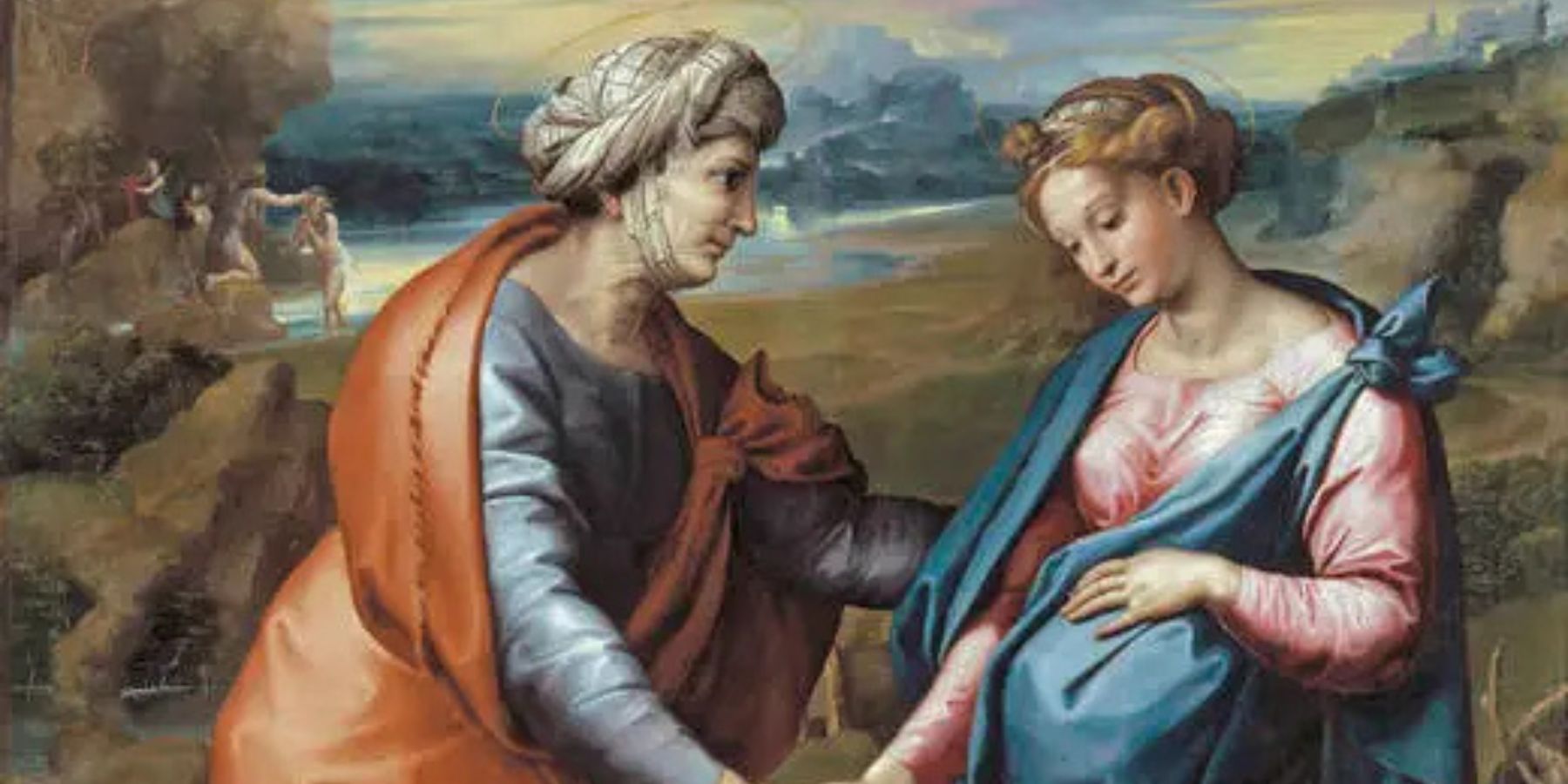
From June 27 to September 27, 2026, the City of L’Aquila and the National Museum of Abruzzo will present one of the most important artistic events of the year in Italy: Raphael’s *Visitation*—a work commissioned by a patron from L’Aquila for a church in the city, now housed at the Prado Museum in Madrid—returns to the city that inspired and commissioned it, for the first time in over four hundred years. Opposite it will be Pontormo’s *Visitation* from Carmignano: a never-before-seen comparison of masterpieces.
There is a story from L’Aquila hidden within one of Raphael’s most famous paintings. And on June 27, 2026, after more than four centuries, that story will return home.
The City of L’Aquila and the National Museum of Abruzzo present “The Visitation in L’Aquila: Raphael and Pontormo”: The exhibition, curated by art historians Tom Henry and Federica Zalabra, Director of MuNDA, and housed in L’Aquila’s 16th-century castle, is one of the most representative and scientifically ambitious events in the programfor L’Aquila, Italian Capital of Culture 2026. Through September 27, 2026, the museum will host two of the most celebrated works of Italian Renaissance painting in a direct comparison that has never before been possible: Raphael’s *Visitation*, on exceptional loan from the Prado Museum in Madrid, and Pontormo’s *Visitation*, from the Church of San Michele in Carmignano (Pistoia), owned by the Diocese of Pistoia.
The City of L’Aquila is the main sponsor of the exhibition, which is co-funded under the Restart 2 Program – Priority C: a targeted institutional investment that is part of a series of measures aimed at strengthening the city’s cultural offerings during its year as Capital of Culture. Bringing Raphael’s masterpiece from the Prado in Madrid to L’Aquila—and juxtaposing it with Pontormo da Carmignano—is a cultural decision that required years of diplomatic and scholarly work.
The Story: A Masterpiece from L’Aquila Returns Home
Raphael’s *Visitation* did not end up at the Prado by chance. It has a specific history, and that history leads through L’Aquila.
The work—a panel painting of extraordinary compositional elegance, painted around 1517—was commissioned by Giovanni Battista Branconio, a native of L’Aquila, a trusted confidant of Pope Leo X, and a personal friend of Raphael. Branconio intended it for the family chapel in the church of San Silvestro in L’Aquila: it remained in its original setting for over a century, an integral part of the city’s religious and artistic life, before embarking on the long journey that would take it to Spain and ultimately into the royal collections in Madrid.
The exhibition stems from the need—and the ambition—to symbolically bring this chapter of its history back to L’Aquila: to give the community the opportunity to engage directly with Raphael’s masterpiece and to open new avenues of research into Raphael’s workshop, the network of relationships between artists and patrons, and Branconio’s role as a cultural promoter and mediator in the Rome of Leo X. This initiative was made possible by the collaboration between the City of L’Aquila and MuNDA, which has made this exhibition one of the most significant cultural events of this administration.
“With ‘The Visitation in L’Aquila. Raphael and Pontormo,’ the city is hosting one of the most significant projects of the L’Aquila 2026 initiative: an event that restores to the community a fundamental chapter of its artistic history and, at the same time, propels our region onto the international cultural stage,” declared the mayor of L’Aquila, Pierluigi Biondi. “The return—albeit temporary—of the altarpiece created by Raphael for the Branconio Chapel in San Silvestro represents an extraordinary opportunity to reaffirm the deep bond between the city, its heritage, and the great figures of the Renaissance. This exhibition confirms the ability of L’Aquila and MuNDA to develop ambitious, inclusive cultural projects of high scientific value, capable of resonating with the public, scholars, and future generations.”
The Comparison: Raphael and Pontormo Head-to-Head
The opportunity to display the Prado’s *Visitation* and Pontormo’s *Visitation* from Carmignano side by side is, in the curators’ words, a central and unprecedented feature of the exhibition.
Raphael Sanzio (Urbino, 1483 – Rome, 1520) presents in his *Visitation* the highest synthesis of sixteenth-century classicism: monumental, serene figures; an airy space; and a perfect balance between form and emotion. This work set the tone for many of the pieces from the final period of his career and is essential for understanding the workings of his workshop, which employed artists of the very highest caliber.
Jacopo Pontormo (Pontorme, 1494 – Florence, 1557), with his Visitation of Carmignano (1528–1530), responds with a radically different visual language: figures with elongated necks, draped in cloaks of vivid, otherworldly colors, and an emotional tension that shatters all classical balance. It is one of the seminal masterpieces of Italian Mannerism and one of the most visited works of art in Tuscany.
Comparing them in L’Aquila, in the same room, is not merely an aesthetic exercise: it is a lesson in the history of Italian painting during one of its most transformative periods, between the height of the Renaissance and its crisis.
The Exhibition Itinerary: Two Sections, One Story
The exhibition is spread across two dedicated galleries, set up within the exhibition space of the 16th-century castle, in direct dialogue with MuNDA’s permanent collections.
-
The Visitation by El Prado and Pontormo’s Visitation
The first section is the heart of the exhibition: the two paintings side by side, accompanied by a critical analysis that explores the iconographic and stylistic innovations of Raphael’s Visitation, its connection to the patrons from L’Aquila, Raphael’s new approach to this Gospel subject, and the influence it had on Pontormo’s later work.
-
Branconio Palace
The second section is devoted to Palazzo Branconio in Rome—which no longer exists but was once situated in a highly prestigious location on the road to the Vatican—and to its patron and owner: Giovanni Battista Branconio, the man from L’Aquila who brought Raphael to his city.
Exhibited Materials, Catalog, Accessibility
The exhibition features an unprecedented combination of paintings, drawings, prints, architectural models, archival documents, and digital educational resources: multimedia stations for in-depth exploration, digital reconstructions, and interpretive panels.
The exhibition is accompanied by an illustrated scholarly catalog in Italian, edited by Tom Henry and Federica Zalabra, with contributions by Francesco Desideri, Francesco Paolo Di Teodoro, Bruce Edelstein, and Ana González Mozo. It is available for purchase at the museum bookshop.
MuNDA has developed comprehensive accessibility features: guides in Braille and Minolta print for people who are blind or visually impaired; guides in Easy-to-Read and AAC (Augmentative and Alternative Communication) for people with intellectual disabilities; video guides in Italian Sign Language (LIS) in collaboration with the National Deaf Association; and three specialized guided tours in LIS scheduled for June, July, and September.
Practical Information
| Dates | June 27 – September 27, 2026 |
| Location | MuNDA – National Museum of Abruzzo, 16th-Century Castle, L’Aquila |
| Hours | Tuesday–Sunday: 9:00 a.m.–7:00 p.m. (ticket office closes at 6:00 p.m.) |
| Open on Mondays | July 13 – September 21, 2026 (special hours) |
| Tickets | Full Price €12
Reduced Price €2 Groups (10–25 people) €10 |
Exhibition presented by the City of L’Aquila and the National Museum of Abruzzo. Supported by the City of L’Aquila as part of the Restart 2 Program – Priority C, within the framework of the L’Aquila Italian Capital of Culture 2026 program.